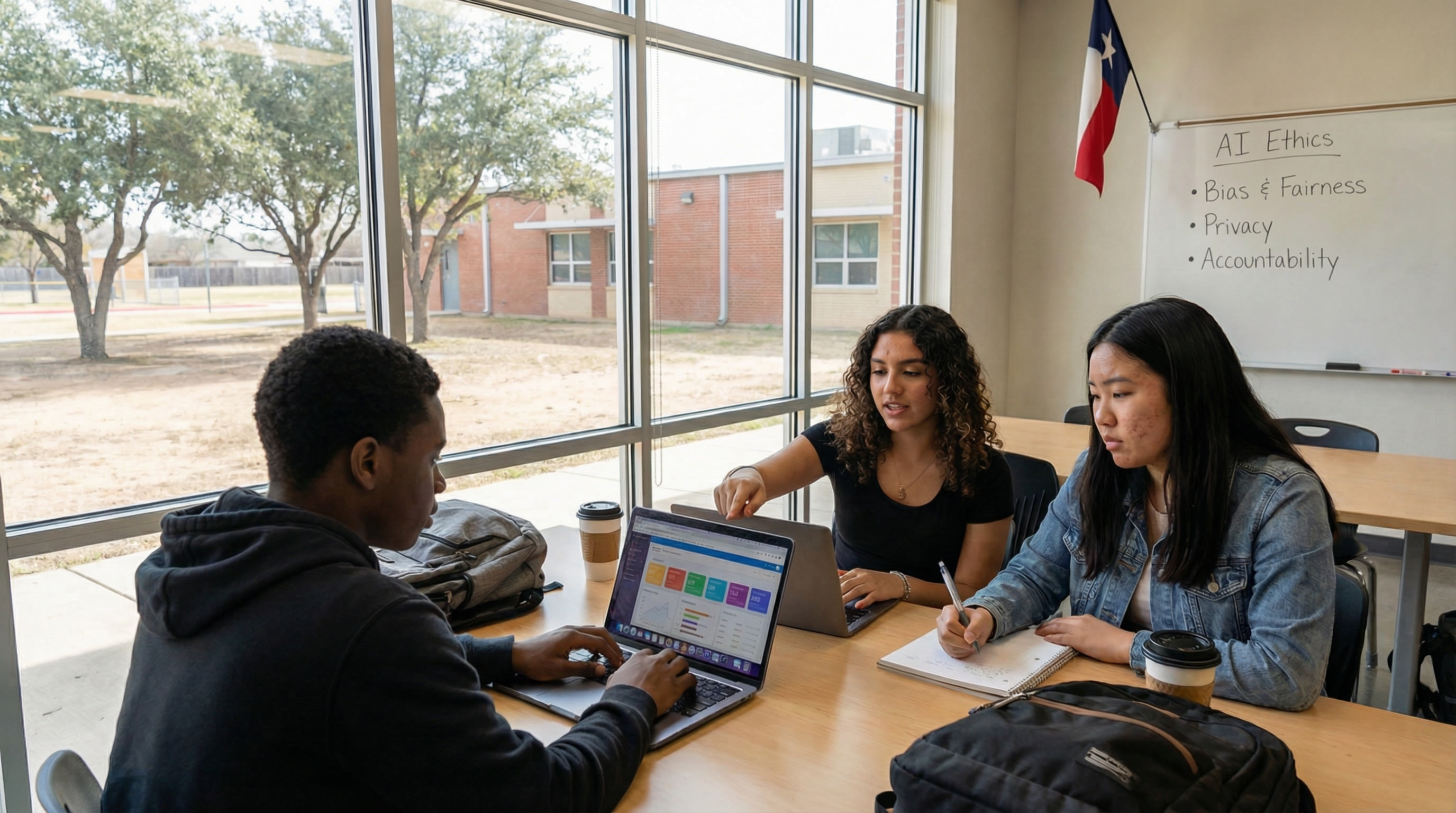
The Urgency
AI is reshaping Texas industries.
Schools need a plan, not a ban.
A child entering kindergarten today graduates college in 2042. By then, AI will be deeply embedded in nearly every industry students enter. OpenAI’s Stargate data center is under construction in Texas. TI, Raytheon, AT&T, and Capital One are integrating AI across operations. The tools, the expectations, and the nature of work itself will look materially different from today.
Yet most schools still optimize for skills AI already does well: memorizing facts, following procedures, standardized problem-solving. Texas does not have a statewide AI-specific CTE Program of Study. Students are being trained to compete with machines — and machines will always win that competition.
This pathway teaches the four capabilities that stay valuable regardless of which tools dominate next year: orchestrating AI systems, exercising human judgment, learning how to learn, and building real things. HB 1525 provides CTE funding weights of 1.28–1.47 for approved Programs of Study. The infrastructure is ready. The gap is the pathway itself.
- Shift from memorization to orchestration — students learn to direct AI, not compete with it
- Cultivate the human capabilities — creativity, ethics, leadership — that compound over a career
- Build metalearning habits so students can adapt as tools and industries evolve
- No AI-specific CTE pathway exists in any Texas Program of Study — this fills the gap
- HB 1525 CTE weighted funding creates a direct financial incentive for new pathways

The Core Framework
Four skills that outlast every tool update
Schools that teach students about AI give them a semester of relevance. This pathway teaches them four capabilities that stay valuable regardless of which tools come next — starting from Day 1, in every course.
Not just using one chatbot — understanding how AI systems work and combining multiple tools to accomplish complex goals. Prompt engineering, output evaluation, multi-tool workflows. This is becoming a foundational literacy for school, work, and civic life.
Genuine creativity, emotional intelligence, ethical judgment, leadership. These aren’t “soft skills” — they’re the most durable human advantages in an AI-saturated economy. Every course cultivates them through community engagement, ethical reasoning, and collaborative problem-solving.
Facts change. Tools evolve. The only permanent skill is the ability to learn new things rapidly. Students practice metalearning throughout the pathway: approaching new domains, identifying what matters, evaluating their own understanding, and adapting as technology shifts.
Every course involves making things that didn’t exist before — not worksheets, not standardized tests. AI self-portraits, bias audit campaigns, community solution prototypes, professional portfolios, public capstone projects. The future belongs to builders.
Differentiation
Why this pathway instead of a generic AI curriculum
National vendors offer semester-long AI survey courses — useful introductions, but they stop at awareness. This pathway is built for institutional adoption: a multi-year program of study with credentials, internships, and Texas industry relevance that a one-semester product cannot provide.
- Teaches students about AI — awareness without application
- No progression from literacy to orchestration to professional practice
- Zero project-based learning, zero work-based learning hours
- Geography-agnostic — same content in Maine and Texas
- Annual participation fees ($500–$950/school) plus $500–$1,200 teacher PD
- No credentials, no postsecondary articulation, no portfolio
- Does not qualify students as CTE concentrators or completers
- 3-course sequence built around AI orchestration, not just awareness
- Human-exclusive skills — creativity, ethics, leadership — in every course, not an elective add-on
- Metalearning practiced throughout: students learn how to learn new tools and domains
- Students build real things from Day 1 — portfolios, prototypes, public capstones
- 80+ hours of work-based learning with Texas employers; AI-900 certification included
- Grounded in Texas industries — built for Perkins V and HB 1525 weighted funding
- Designed to support community college partnerships, dual-credit exploration, and postsecondary transition
For Decision-Makers
Why administrators say yes to this model
If the four pillars make the educational case, this section makes the operational one: funding, staffing, compliance, and visibility.
Designed for Perkins V and HB 1525 CTE weighted funding tiers (1.28–1.47 in approved Programs of Study). Total program cost may fall below the formal competitive procurement threshold (SB 1173), subject to district policy and funding-source requirements. Districts may also use cooperative purchasing pathways such as TIPS or BuyBoard when available through an awarded vendor.
Runs on existing Chromebooks and laptops with browser-based tools. No new labs, no expensive software licenses, no specialized hardware. Phased rollout lets schools start with a workshop or single course before committing to the full sequence.
No coding prerequisites. No computer science department required. Designed for broad student participation across backgrounds, skill levels, and interests — making AI literacy accessible to every student, not just the ones who already code.
Connects AI to real Texas industries and employers — Texas Instruments, AT&T, Raytheon, Capital One, Baylor Scott & White, UT Southwestern, energy companies. Students see how AI shapes the economy they’ll enter, not abstract Silicon Valley case studies.
Built with privacy, ethics, and teacher oversight at the foundation. Structured to support district compliance review from the start. Teacher-managed AI accounts, parental consent processes, content filtering, and a maintained tool compliance matrix.
Creates outcomes communities can see: student portfolios, Microsoft AI-900 certifications that count toward CCMR accountability, capstone showcases, and internship placements.
“Texas sits at the intersection of frontier technology and the most diverse communities in the country. This pathway bridges that gap — giving every student, not just the ones who already code, a real seat at the table.”The Crossroads — Design Philosophy
Student Outcomes
What students walk away with
- AI orchestration fluency The ability to evaluate, combine, and direct multiple AI tools toward complex goals — not just chat with a bot, but orchestrate systems.
- A professional portfolio of things they built Curated artifacts from every course: bias audits, community prototypes, creative works, and a public capstone project addressing a real Texas challenge.
- Human skills that compound Three years of practiced ethical reasoning, creative problem-solving, community engagement, and collaborative leadership — the hardest capabilities to automate and the most valuable to employers.
- The ability to learn what doesn’t exist yet Metalearning practice throughout the pathway: approaching unfamiliar domains, evaluating new tools, adapting as technology evolves.
- 80+ hours of real work experience plus credentials Structured internship with a Texas employer. Microsoft AI-900 certification (TEA 2025–2030 IBC approved, counts toward CCMR). Potential dual-credit or articulation pathways with community college partners such as Dallas College.
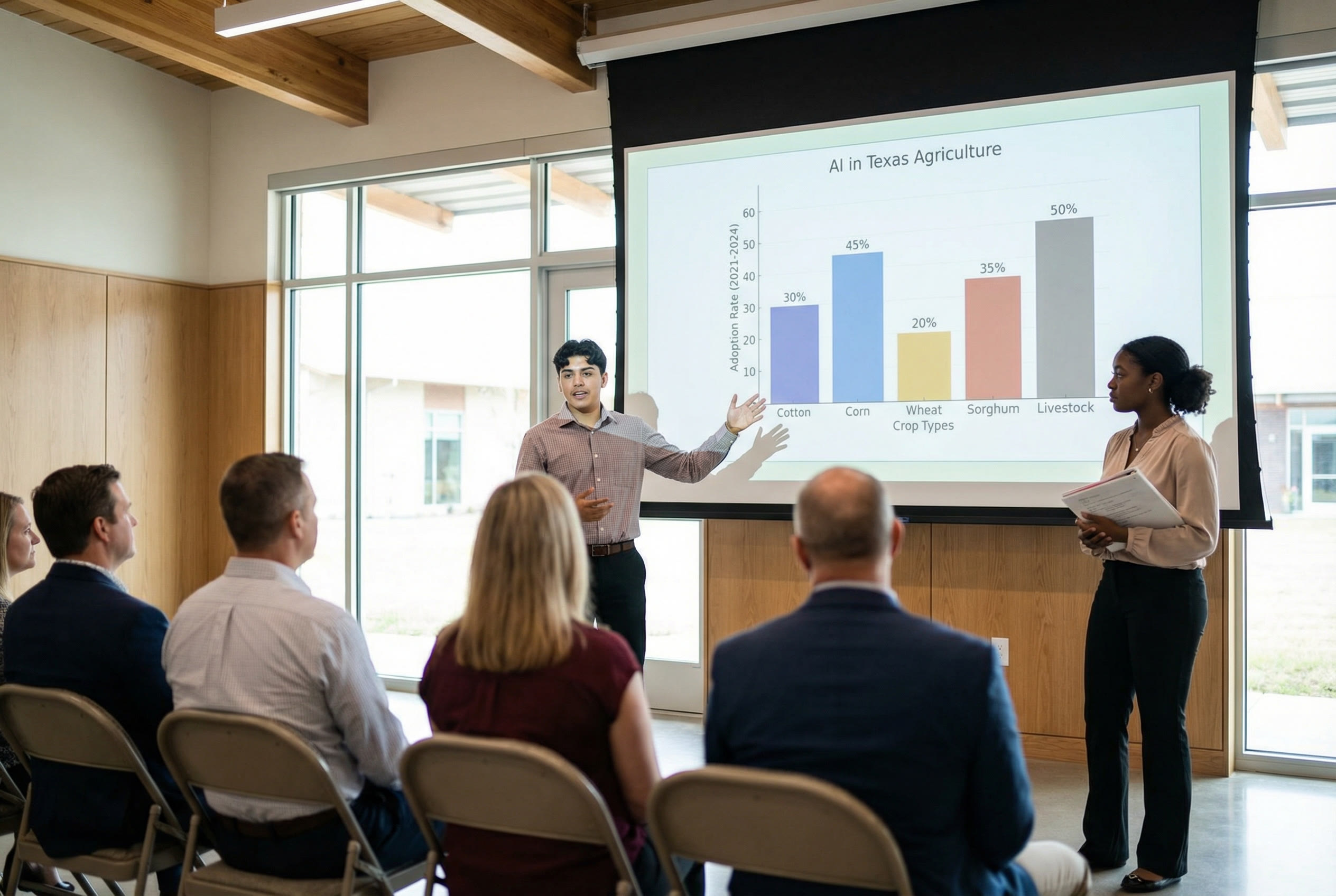
Lowest-Risk Entry Point
Start with a summer workshop
Not ready to launch a full pathway? Start with the 5-day summer workshop. It introduces the same four pillars in compressed form: students learn how AI works, practice judgment and creativity, adapt quickly across unfamiliar tools, and build public-facing work — all in one week. It gives schools a visible, community-friendly way to test demand, recruit students, and demonstrate what AI education actually looks like.
Demystify AI through hands-on stations. Train classifiers, interrogate chatbots, map AI in your daily life. Build an AI self-portrait of future Texas.
Train classifiers with local data, run bias labs on image generators, encounter deepfakes. Build a “Fix the Bias” campaign using real-world Texas datasets.
Visual storytelling, narrative co-writing, AI music. Create “Postcards from Future Texas” and a collaborative digital mural inspired by Dallas’s arts district.
Case studies: water management, energy grid optimization, healthcare diagnostics, precision agriculture, defense systems. Guest speaker from Texas tech industry. Launch culminating projects.
Finalize “AI for Good in Texas” projects. Public showcase for families, community college faculty, industry partners. Pathway enrollment information.
- Low-risk pilot before full pathway implementation
- Student recruitment tool for the 3-course sequence
- Family and community engagement moment
- Early proof point for district leaders, school boards, and prospective partners
- Professional development opportunity for CTE staff
- Functions as a smart first step, not a side event
The Program of Study
A practical way to launch AI education in Texas high schools
This is not a full computer science rebuild. It is a 3-course CTE pathway where the same four pillars deepen over time: Course 1 builds literacy and confidence, Course 2 develops orchestration and ethical judgment, and Course 3 applies all four in real workplaces and public-facing projects. Each course maps to existing Texas TEKS within the Information Technology career cluster. Schools can adopt in phases.
-
Unit 1 — Weeks 1–3
What Is AI?
Defining AI, brief history, AI in daily life, the hype cycle. Unplugged sorting games and Turing tests. “AI Audit” of students’ own tech use. Texas connection: how AT&T, TI, and Capital One use AI in Dallas–Fort Worth.
-
Unit 2 — Weeks 4–6
How AI Sees the World — Perception
Sensors, computer vision, speech recognition, NLP basics. Train image and sound classifiers with Teachable Machine. Texas connection: semiconductor sensors in North Texas, defense and sensing applications in the DFW aerospace corridor.
-
Unit 3 — Weeks 7–9
How AI Thinks — Representation & Reasoning
Data foundations, decision trees, knowledge graphs, recommendation systems, intro to neural networks. Texas connection: Capital One fraud detection, ERCOT energy grid management.
-
Unit 4 — Weeks 10–12
How AI Learns — Machine Learning
Supervised, unsupervised, and reinforcement learning. Generative AI basics and the training data supply chain. Texas connection: precision agriculture in the Rio Grande Valley, energy exploration and optimization workflows across the Texas oil and gas sector.
-
Unit 5 — Weeks 13–15
AI, Bias & Society
Algorithmic bias, data sovereignty, surveillance and privacy, environmental cost of AI, regulation. Bias Audit project and Community Perspectives Panel. Texas connection: automated scoring debates in student assessment, facial recognition policy debates in Texas.
-
Unit 6 — Weeks 16–18
AI Futures — My Voice, My Community
AI workforce landscape, Texas AI careers, capstone communication project for a public audience. Portfolio assembly and pathway planning. Texas connection: Stargate, DFW tech ecosystem, healthcare AI at UT Southwestern.
Frameworks: AI4K12 Five Big Ideas, ISTE Standards, UNESCO AI Competency Framework, UbD, UDL, PBL, MIT RAISE
Tools: Google Teachable Machine, ChatGPT Education, Hugging Face Spaces, TensorFlow Playground, Canva, Google Sites
-
Unit 1 — Weeks 1–3
Power User — Advanced AI Interaction
Prompt engineering, multi-modal AI, output evaluation, academic integrity. Compare ChatGPT, Gemini, Claude, and open-source models. Texas connection: how DFW tech companies evaluate AI tools.
-
Unit 2 — Weeks 4–6
Ethics Lab — Frameworks for Hard Questions
Consequentialism, deontology, virtue ethics, care ethics. FATE framework. Deep case studies including Texas-specific AI dilemmas: energy grid decisions, healthcare triage, border surveillance, hiring algorithms.
-
Unit 3 — Weeks 7–10
AI Across Domains — Applied Intelligence
Healthcare, environment, creative arts, journalism, education, government, business. Domain deep dives with Texas industry connections: healthcare AI and clinical decision-support in major Texas health systems, energy exploration and optimization, Dallas Arts District generative media.
-
Unit 4 — Weeks 11–15
Design Thinking + AI — Community Solutions
5-week PBL: identify a real Texas community problem, conduct empathy interviews, design an AI-informed solution, present to community panel. Partners: local nonprofits, municipal offices, healthcare providers.
-
Unit 5 — Weeks 16–18
Portfolio & Professional Readiness
Digital portfolio curation, resume writing, mock professional interviews, internship preparation. Microsoft AI-900 certification alignment and exam preparation.
Key credential: Microsoft AI Fundamentals (AI-900) alignment. Conceptual domains accessible with Course 1+2 preparation. On TEA 2025–2030 IBC approved list.
Additional tools: Perplexity AI, Runway ML, Suno AI, NotebookLM, Figma, Miro, Kialo, Google Colab
-
Unit 1 — Weeks 1–3
Professional Launch
Workplace expectations, internship orientation, professional communication, workplace AI audit, capstone topic exploration and proposal. Texas industry partner matching and onboarding.
-
Unit 2 — Weeks 4–12
Internship Immersion + Capstone Development
Minimum 80 hours on-site, remote, or hybrid with a Texas employer. Weekly classroom seminar for reflection, capstone workshops, guest speakers, advanced AI topics. Supervisor evaluations at weeks 6 and 12.
-
Unit 3 — Weeks 13–18
Capstone Completion & Public Showcase
Intensive capstone production, peer review, comprehensive portfolio assembly, public presentation to industry partners, community college faculty, families, and community members. Pathway exit interview and postsecondary planning.
Target internship partners: Texas Instruments, AT&T, Raytheon, Lockheed Martin, Capital One, Baylor Scott & White, UT Southwestern, Children’s Health, Parkland, ExxonMobil, Dallas startup ecosystem, municipal technology offices, nonprofits
Target credential: Microsoft AI Fundamentals (AI-900) — on the TEA 2025–2030 IBC approved list. Additional pathway micro-credentials issued by the program.

Program at a glance
Implementation
What it takes to launch
School leaders need to know whether a new program is realistic. This one is built to be. Schools can start with a workshop, a single-course pilot, or a phased multi-year rollout — with regional ESC consultation potentially available for implementation planning.
- 1 CTE instructor with AI literacy professional development
- Existing Chromebooks or laptops — all tools are browser-based
- Teacher-managed AI tools with documented parental consent process
- Pathway or pilot timeline — start with workshop, Course 1, or full sequence
- ESC Region engagement — regional CTE specialists may assist with integration, advisory development, and employer connections
Recommended timeline
- Summer 2026 Pilot summer workshop; teacher PD; employer recruitment
- Fall 2026 Launch Course 1 pilot with first cohort (25–30 students)
- Spring 2027 Launch Course 2; refine Course 1 based on pilot data
- Fall 2027 Launch Course 3 capstone/internship; first full-pathway cohort
- 2028–29 Full operation, first graduates, potential expansion through additional ESC regions
Funding Fit
How Texas schools can fund it
This pathway is built to align with the funding structures Texas districts already use to launch and sustain CTE programs. It does not require new funding streams — it fits the ones already in place.
- Perkins V for curriculum, professional development, devices, certification exam fees, and WBL coordination
- HB 1525 CTE Weighted Funding — 1.28 weight for Level 1–2 courses, 1.47 for Level 3–4 courses in approved Programs of Study
- Under $100K procurement threshold (SB 1173) — may qualify for direct purchase, subject to district policy
- Purchasing cooperatives — districts may use cooperative purchasing pathways such as TIPS or BuyBoard when available through an awarded vendor
1S1 Graduation Rate • 2S1 Academic Proficiency • 3S1 CTE Concentrator Proficiency • 4S1 Non-Traditional Participation • 5S1 Program Completion • 5S2 Postsecondary Placement
TEA CTE structure alignment: Information Technology Career Cluster • Concentrator at 2+ courses/2+ credits • Completer at 3+ courses/4+ credits with Level 3–4 course • TEKS-based course mapping (§127.671, §127.721, §127.735)
HB 1525 weighted funding in dollars:
Level 1–2 student ≈ $6,160 × 1.28 = ~$7,885/ADA
Level 3–4 student ≈ $6,160 × 1.47 = ~$9,055/ADA
vs. non-CTE student = $6,160/ADA
Funding references describe alignment and fit, not guaranteed funding. Consult your district CTE coordinator and ESC Region specialist for specific Perkins eligibility and weighted funding qualification.
Who Built This
Designed for credibility from day one
This pathway is not a concept — it is a fully designed program of study developed by someone who has built university programs from scratch and understands how curriculum moves from vision to classroom.
Common Questions
What decision-makers ask first
No. The model is built around literacy, ethics, and practical career relevance — not trend-chasing. It gives schools a structured response to technology students are already using. The curriculum is grounded in established frameworks (AI4K12, ISTE, UNESCO), aligned to existing Texas TEKS, and designed for long-term CTE viability, not a one-year experiment.
No. This pathway is designed for CTE adoption within the Information Technology career cluster, not a full CS rebuild. It requires one CTE instructor with AI literacy professional development. No coding prerequisite is required. The pathway emphasizes AI literacy, judgment, and creation first; any technical work is introduced accessibly and in context.
No. The entry point is open-access and built for broad participation. Course 1 requires zero prerequisites beyond basic digital literacy. Students who can use a web browser and create documents are ready to begin.
Yes. The entire tool stack is browser-based and Chromebook-compatible. Google Teachable Machine, ChatGPT Education, Canva, Google Workspace — all free or low-cost, all running in a browser. No specialized hardware, no new lab setups, no expensive software licenses.
The model is structured around teacher-managed accounts, documented parental consent, no student PII in AI tools, content filtering on all devices, and a maintained tool compliance matrix. All AI interactions happen through education-licensed accounts under teacher oversight. Designed to support district privacy and compliance review processes.
Start with the 5-day summer workshop or a Course 1 pilot. The model is intentionally phased. Many schools will begin with the workshop as a recruitment and proof-of-concept event, then add Course 1, then build the full pathway over 2–3 years as demand and capacity grow.
Because tool-specific training expires quickly. The durable value is not memorizing one platform’s interface, but learning how to evaluate tools, direct them well, exercise judgment where automation falls short, keep learning as systems change, and build work that matters in the real world. Those four capacities stay useful even as specific products come and go.
Course 1 introduces all four: students learn what AI is, begin evaluating and directing tools, practice ethical judgment, and build their first projects. Course 2 deepens orchestration with multi-tool workflows, applies human-centered design to real community problems, and builds professional portfolios. Course 3 applies all four in internships and capstones, where students must learn an unfamiliar domain quickly, exercise judgment under professional conditions, and build work for real audiences.
Each course maps to existing Texas TEKS within the Information Technology career cluster. When placed in an approved Program of Study, courses qualify for HB 1525 CTE weighted funding: 1.28 for Level 1–2 courses (Course 1) and 1.47 for Level 3–4 courses (Courses 2 and 3). That translates to approximately $1,700–$2,900 in additional per-pupil funding above the basic allotment. Consult your ESC Region CTE specialist for specific POS placement guidance.
The pathway aligns to the Microsoft AI Fundamentals (AI-900) certification, which is on the TEA 2025–2030 Industry-Based Certification approved list. AI-900 counts toward CCMR accountability indicators, giving your school measurable outcomes for state reporting.
Explore whether this pathway fits your school, district, or region.
Start with a planning call, a workshop, or a pilot-year conversation. We’ll walk through whether this four-pillar model fits your students, your staffing reality, and your CTE goals — then map the most practical launch path for your district.
For CTE directors, principals, ESC specialists, and district administrators evaluating future-ready CTE options for Texas students.
Questions? Reach us at [email protected]